
The 1800's

01
In the beginning....
Originally Aldershot came under the western part of the Southwark Diocese, and Bishop Grant, the first Bishop of Southwark, had a great love for the army. He knew a great deal about Aldershot from personal experience, and from conversations with his Father who had been in the 71st Foot Regiment. It was because of his efforts that the Catholic chaplains had been appointed to the Army. He himself loved to be with the solders. Consequently he was very often at Aldershot. In September 1859 he was nearly killed there. he was on his way to give Confirmation at North Camp. An Irish jaunting car had been sent to meet him; unaccustomed to that primitive conveyance he did not take the precaution of holding on, and at a sudden bump of the car over a stone, he was thrown off head foremost and lay insensible on the road while the driver, not realising, went bumbling on until he came to his destination, and then discovered that the Bishop was gone! Everyone was alarmed, Canon Ringrose (Rector of St James, Reading) rushed back to look for him and found him where he had fallen, still insensible. He recovered, but not before rumour went around that he was dead. The French Ambassador had occasion to see the Queen just at the time, and Her Majesty expressed sorrow at the loss of so good a man, whose death would be so bitterly felt by all her Catholic subjects.
In 1855 two Garrison churches were opened by the War Office, one in South Camp, the other in North Camp. The church in South Camp was shared by Catholics and Anglicans. In 1863 the Anglicans opened their own Garrison Church, and the former shared church became solely used by Catholics, and was dedicated to St Michael and St Sebastian. The first Chaplain was Mgr John Vertue, later to be the first Bishop of Portsmouth.
02
Late 1860's - The Original Catholic Mission Began...
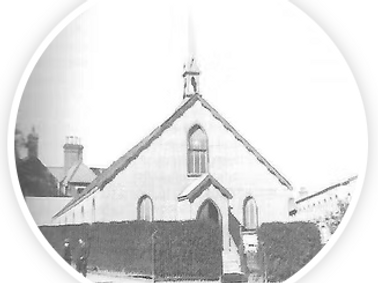
The population of Aldershot in 1869 was estimated at 7,500, of whom it was thought 1000 were Catholics. It was evident that the Chaplains could not adequately deal with the situation. They had done what they could, and in 1867, Fr McCarthy, one of the Assistant Chaplains, opened a room in the present High Street as a school. Forty-eight children attended, the number rising in the following year to sixty-seven. In 1869 Bishop Grant decided to make better provision for the town and district. He appointed Fr Purcell in charge, and he is considered to be the first Diocesan Priest in charge of the Mission. A disused public house was rented for £45 a year, and served both as school and chapel. The actual building still exists at the corner of Alexandra and Cambridge Roads, opposite the former Franciscan Convent and residential children's home. There was a wooden building at the rear of the public house which was used as a chapel. The largest room in the house served as a school room. One of the upstairs rooms was used as a sacristy, and the rest of the house served as a residence of the school mistress. The Priest lived in lodgings nearby. The solemn opening of the chapel took place on the 29th July 1869. Bishop Grant was too unwell to be present. The Right Rev Dr Morris, Titular Bishop of Troy, officiated at the high Mass. It is on record that Mozart's 12th Mass was rendered, that the band of the 25th Regiment played, and that a lunch took place afterwards at the house opposite at which 46 persons were at present. The mission did not consist of Aldershot only; it reached to Finchampstead, Broadmoor and Bagshot in the north; Pirbright, Puttenham and Elstead in the east; Frensham, Kingsley and Alton in the South: Odiham, Hook and Bramshill in the west. The area was therefore about 60 miles in circumference. It was felt at once that some provision had to be made for Catholics in the neighbourhood of Sandhurst and York Town. In September 1869 a room was taken in The Staff Hotel, at what was known as Cambridge Town, and Mass was said there on the 17th September, Feast of the Stigmata of Saint Francis. Fr Purcell also had to look after Broadmoor (then called Criminal Lunatic Asylum) and also to say Mass from time to time at Frensham where the Woodruffs lived. The work broke his health. He was forced to resign in 1871 but not before he had bought a plot of land at the junction of the Queen's Road and Edward Street. He paid £400 for it upon it now stands the present church of St Joseph.

03
Early 1870's - A School and a Presbytery
In November 1871 Fr Louis Hall was transferred from St Joseph's, Southampton to Aldershot. The following year he purchased a site in Queen's Road, and two years later the first instalment of St Joseph's School, including a school chapel, was built. Fr Hall later erected St Joseph's Presbytery. In 1874 he was moved to Reading and his place was taken by Fr Richard Davis.
Early 1880's - Portsmouth Diocese is Born
In May 1882 the division of the Diocese of Southwark took place and henceforth Aldershot was to be in the Diocese of Portsmouth. As Canon Francis O'Farrell in his history put it: "It was a special pleasure to welcome as first Bishop of the new See, him who had been the first priest to reside in the district since pre-Reformation days, the first Chaplain of South Camp, Mgr John Vertue". In August of that year Bishop Vertue made a change at Aldershot. He sent Fr Justin Mooney who built an iron church with accommodation for 400. It was opened on the feast of Corpus Christi 1883 and served its purpose long and well, until Sunday 27th August 1911. It was then dismantled and transferred to Belle Vue Road, North Town, Aldershot as the predecessor to the present St Mary's church.
04
Mid 1880's - Priest and Cavalry fall out plus Winston Churchill is chastised
In 1884 Fr Edward Riordan succeeded Fr Mooney. He brought the Sisters of Mercy from Abingdon to look after the school. Unfortunately, owing to financial difficulties, the Sisters had to leave in 1889. Their place was later taken by the Franciscan Sisters. The following is taken from Canon Francis O'Farrell's history: "There is one point of information concerning the attendance of the Cavalry at St Joseph's that I have not referred to in my notes. It is quite true that they (the Cavalry) so attended for a number of years. It was more the nature of a private arrangement made between Fr Riordan and friendly Senor Chaplains than anything else. No payment was received on account of their attendance, though the men used to put something into the collection. The arrangement came to an end through the men complaining of Fr Riordan's habitual unpunctuality in starting Mass, which meant that they arrived back at the barracks late for dinner. Fr Riordan refused to change his habit, and urged that as he was not paid for the attendance of the men, the authorities had no right to call attention to his failing. The men were therefore withdrawn. Fr Riordan then promised to amend, and applied to the War Office for a revival of the old arrangement, but in vain. It was during the time that the Cavalry did attend that Fr Riordan felt obliged to rebuke a subaltern in charge of the Church Party for what he thought unseemly behaviour, by his lolling about and showing inattention. An apology set the matter right, else the young officer would have lost his commission. The subaltern was Winston Churchill, so famous later as Minster of State".
Click here to continue our journey to the 1900's


